
via FreeCodeCamp
How AI Receptionists Work: The Architecture Behind AI Phone Agents
ai phone agentai receptionistbusiness automationcall routingconversational ai architecturenatural language processingspeech recognitiontelephony integration
AI receptionists might seem deceptively simple from a caller's perspective: you speak, the system responds, and the dialogue continues until your query is resolved or you're connected to a human. Behind this seamless interaction, however, lies a sophisticated pipeline integrating telephony infrastructure, speech recognition, language models, application logic, APIs, databases, and intelligent call routing.
The true complexity—and value—doesn't reside in a single AI model. Rather, it emerges from how these components orchestrate together, transforming raw audio streams into actionable business outcomes. As of 2026, this architecture has matured significantly, with advancements in real-time processing and context retention enabling more natural and efficient interactions than ever before.
For businesses seeking these capabilities, there are two primary paths. They can adopt ready-made solutions—the market now features dedicated AI receptionists like XBert from Nextiva, Goodcall, Dialzara, and others, each with unique strengths and trade-offs. Alternatively, they can build a custom system, which this article will explore in depth. Understanding the underlying architecture benefits both routes: it clarifies what commercial products do under the hood and outlines what a bespoke solution must assemble.
A typical architecture might resemble the following:
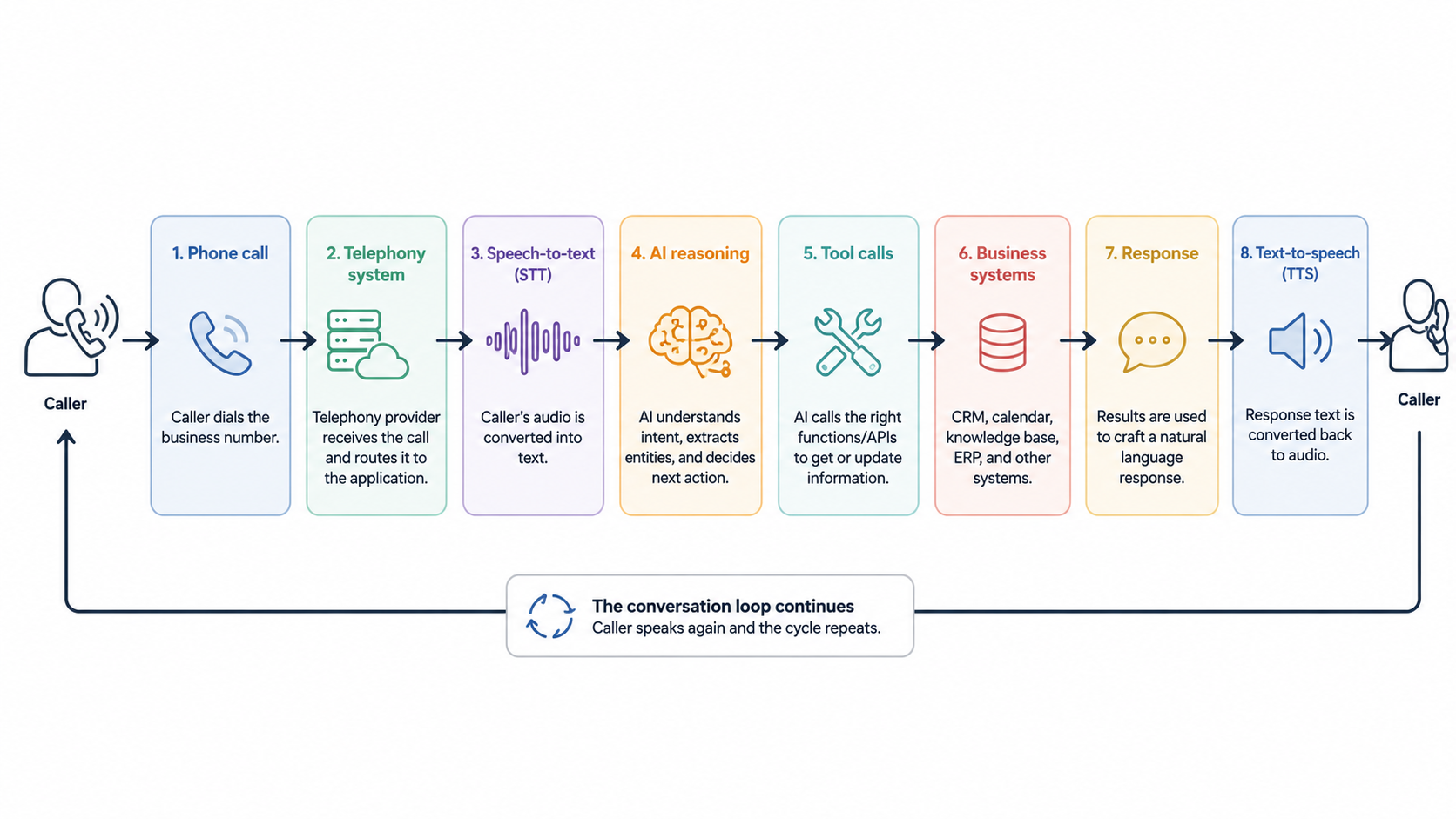
In this article, we'll dissect the architecture behind an AI phone agent, tracing the journey from the moment a caller dials a business number through the post-call actions. You'll discover how telephony systems manage calls, how speech is converted to text, how AI discerns intent and preserves conversational context, and how function calls link the agent to calendars, CRMs, and other enterprise tools. We'll also examine how agents determine when to escalate a call to a human representative and the information they carry into that handoff.
← Previous
Agentic AI Engineering in Practice: How AI Engineers and For...
Next →
The AI Revolution in Patching: A Developer's Guide to Exposu...