
FAQ as RAG: When You Get to Design the Corpus
Enterprise Document Intelligence [Vol.1 #B2] - The FAQ inverts every brick of the standard RAG pipeline. Parsing is trivial, retrieval doubles as a cache, and few-shot prompting becomes a retrieval problem too.
A FAQ is already the answer, pre-written and paired with its question. Ask “What is my deductible?” and the right response is a lookup away: the support team wrote it, word for word, months ago. Run the FAQ through the same embed-and-retrieve pipeline as a raw PDF and you throw that structure away, often returning a worse match than a plain lookup would. When the source is already question-and-answer, the RAG has to treat it that way.
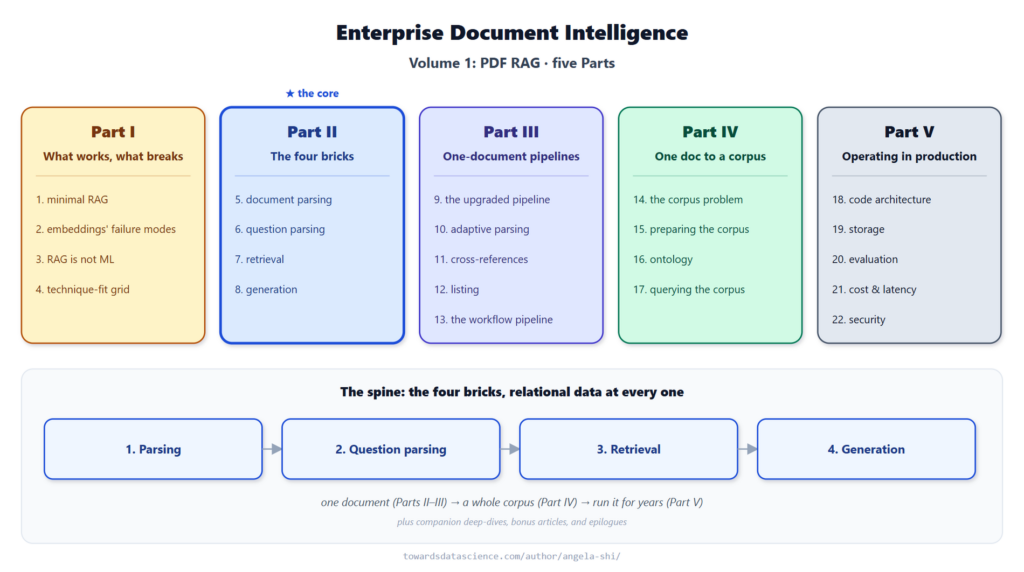
This article is a bonus in Enterprise Document Intelligence, a series that builds an enterprise RAG system from four bricks. FAQ as RAG is the case where you get to design the corpus: every brick inverts, parsing is trivial, retrieval doubles as a cache, and few-shot prompting becomes a retrieval problem too.
🧭 New to the series? Every article in this series sits on our two Towards Data Science author pages, Angela Shi and Kezhan Shi. That is the shortest way to see what is covered and where this one sits.
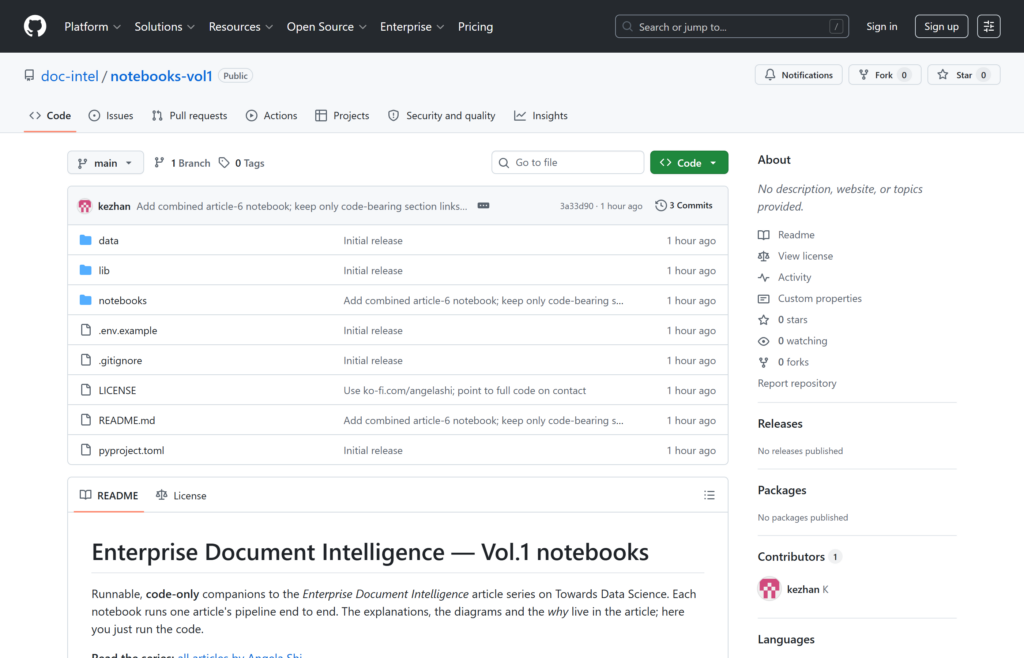
📓 Runnable companion notebooks are on GitHub: doc-intel/notebooks-vol1.
Pull the logs of a customer-support chatbot a few weeks after launch, and you will notice a pattern: a handful of questions repeat across thousands of conversations. In 2026, with generative AI embedded in every customer-facing interface, the volume of such repetitions has only grown. The FAQ—once a static help page—has become a living corpus, updated by support teams, product managers, and even AI-assisted tools. When you get to design the corpus, the FAQ is the ideal RAG case: structured, curated, and already aligned with user intent.
Why a FAQ Inverts the Standard RAG Pipeline
In a classic RAG system, you start with messy documents—PDFs, wikis, emails—and spend most of your effort on parsing, chunking, and cleaning. With a FAQ, the data is already structured: each entry has a question and an answer. Parsing becomes trivial, and the real challenge shifts to retrieval and ranking. Moreover, because the FAQ is designed to answer questions, the retrieval step doubles as a cache: if the same question or a close variant appears, you can return the pre-written answer without invoking the LLM at all. This is a profound inversion: instead of using retrieval to feed the model, you use retrieval to bypass it when possible.
The Three Bricks Inverted
Consider the three engineering layers of a RAG system: parsing, retrieval, and generation. In a FAQ corpus, parsing is a non-issue—you import the CSV or JSON directly. Retrieval, however, becomes a caching layer: you can store question-answer pairs in a vector database, and use semantic search to find the nearest match to the user's query. If the similarity score exceeds a threshold, you return the answer directly, skipping the generative model. This not only saves latency and cost but also ensures consistency and accuracy, as the answers are human-approved. For generation, few-shot prompting is no longer a static set of examples—it becomes a retrieval problem. You retrieve the most relevant FAQ entries to include as few-shot examples, dynamically adapting the prompt to the user's intent.
Designing the Corpus for Maximum Value
When you have the luxury of designing the FAQ corpus, you can optimize for retrieval effectiveness. Start by ensuring each question is written as a user would ask it, not as an internal support agent would phrase it. Use natural language, include synonyms and common misspellings, and consider adding multiple formulations per answer. In 2026, with multilingual support and voice interfaces, it is also wise to include variations across languages and dialects. Additionally, maintain metadata: the department, the last update date, and the confidence score from past interactions. This metadata can be used for filtering during retrieval, improving precision.
Retrieval as Cache: Practical Implications
The "retrieval as cache" idea has practical implications for enterprise architecture. If 80% of customer questions are already answered by the FAQ, you can serve those instantly, with zero LLM inference. Only the remaining 20% go to the generative model, and even then, you can use the FAQ to provide few-shot examples. This hybrid approach, increasingly popular in 2026, reduces costs and improves reliability. It also enables you to log retrieval failures, which become valuable signals for updating the FAQ—closing the loop between the RAG system and the corpus design.
Few-Shot Prompting as a Retrieval Problem
When the LLM must generate a response, the FAQ acts as a dynamic few-shot store. Instead of hand-picking three examples, you retrieve the top-k most similar question-answer pairs and include them in the prompt. This approach leverages the same retrieval engine, keeps the prompt relevant, and scales with the corpus. The key is to balance the number of examples: too few and the model may drift; too many and you exceed the context window. In practice, k=3-5 works well, and you can tune it based on the domain and the model's capacity.
Conclusion
The FAQ is not a poor cousin to raw documents; it is a strategic asset. When you design the corpus, you can invert the RAG pipeline to your advantage: trivial parsing, retrieval as cache, and dynamic few-shot prompting. In 2026, as enterprises seek to deploy LLMs efficiently and accurately, this approach offers a blueprint that is both practical and scalable. The key takeaway: embrace the structure you have, and let the corpus shape the system—not the other way around.
This article is part of the Enterprise Document Intelligence series. Explore the other volumes to see how these principles apply to raw PDFs, wikis, and beyond.