
When to Use Claude Code and When to Use Codex
Learn where which coding agent is best
By Eivind Kjosbakken | August 29, 2026 | 8 min read

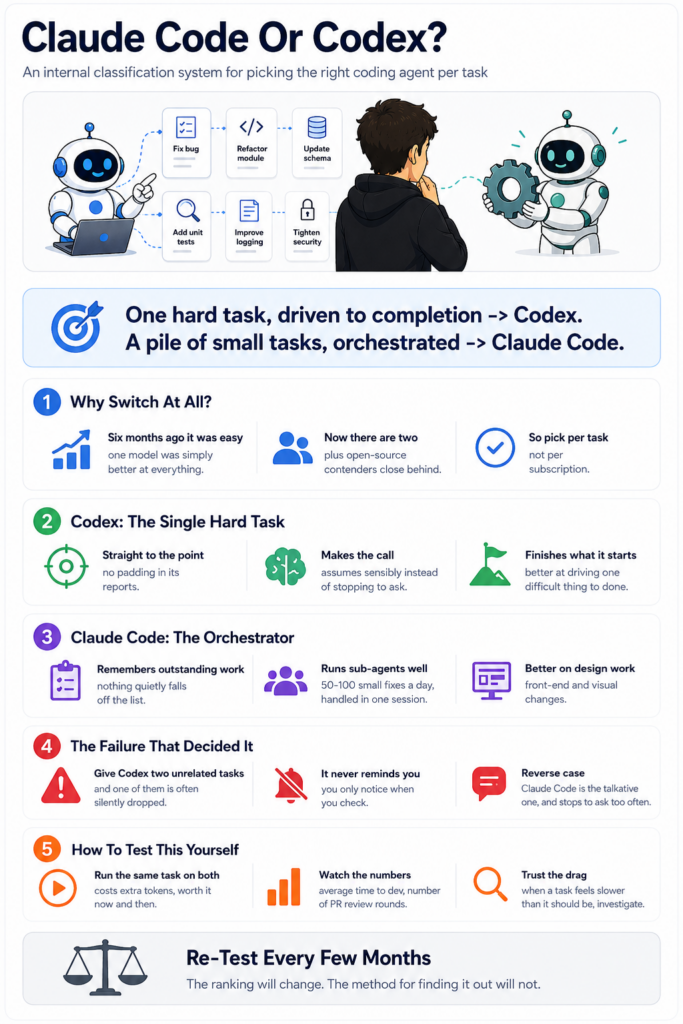
As of 2026, the two frontier coding agents—by a long shot—are Claude Code and Codex. However, I've noticed significant differences in when each model excels, and each has real downsides. So I've developed an internal classification system I use every time I start a new task, to decide whether I should use Claude Code or Codex. In this article, I'll share this system, offer my thoughts on when each model is superior, and help you get the most from these coding agents by deploying them on tasks where they perform best.
Why Change Coding Agents Based on Tasks?
Just six months ago, choosing a coding agent was easy: Anthropic's Opus series was far superior across all coding tasks. You could use other models like Google's or Codex, but there was a significant performance gap compared to Opus. That landscape has changed dramatically. Today, I believe there are two frontier models—Codex and Claude Code—with several strong competitors close behind, such as GLM 5.3 and Kimi K3, both excellent but not quite at the level of the frontrunners.
In this article, I'll focus on the two frontier models, though I expect the hierarchy could shift again in a few months. The key lessons here are generic: how to recognize when a coding agent performs well and where it struggles. I'll detail the strengths and weaknesses of Claude Code and Codex, and show you how to identify these traits to choose the best agent for each task—both now and in the future as the ecosystem evolves.
My Classification System: Quick Overview
After months of testing, I've found that Codex excels in complex, multi-file refactoring and tasks requiring deep codebase understanding, while Claude Code shines in rapid prototyping, code explanation, and smaller, focused changes. Below, I'll break down when to choose each.
When to Use Codex
Codex, particularly the latest version available in 2026, has become my go-to for large-scale, architectural tasks. It's surprisingly good at:
- Large refactoring: It can handle sweeping changes across multiple files without losing context.
- Complex debugging: It's effective at tracing logic through a codebase to find root causes.
- Systematic changes: When I need a consistent pattern applied across a project, Codex does it reliably.
However, Codex can be slower and more resource-intensive. For quick, isolated tasks, it might be overkill.
When to Use Claude Code
Claude Code is my choice for speed and simplicity. It's ideal for:
- Rapid prototyping: I can spin up a new project or test a concept quickly.
- Explaining code: Its responses are more educational, making it great for understanding unfamiliar code.
- Small, targeted edits: It handles one-off changes and script work efficiently.
The downside is that Claude Code can sometimes miss broader context in large projects, so it's not my first pick for massive refactors.
Key Factors in Choosing
When deciding, I consider three things:
- Task scope: How many files and how much interdependency?
- Need for context: Does the task require holistic understanding or just local fixes?
- Speed vs. thoroughness: Am I optimizing for quick iteration or deep analysis?
For example, in my recent project, I used Codex to migrate a monolithic codebase to microservices (perfect for its strengths), and Claude Code to write unit tests for new modules (a focused, fast task).
Practical Tips for Getting the Most Out of Each
Here are some tips based on my experience:
- Don't stick to one agent. Switch mid-project if a task changes character.
- Use Claude Code for brainstorming and planning; then use Codex for execution on complex parts.
- Keep your codebase well-organized—it helps both agents perform better.
- Monitor each model's updates; the landscape shifts every few months.
Future Outlook
By late 2026, the gap between Claude Code and Codex is narrowing. Newer models like GLM and Kimi are close, and the generic principles here will outlast any single tool. The key is to stay flexible and evaluate agents on your specific workflows.
Conclusion
Choosing between Claude Code and Codex isn't about finding a 'best' tool—it's about matching the tool to the task. Codex handles heavy lifting; Claude Code excels in speed and explanation. By applying a simple classification system based on scope, context, and speed needs, you can get the best results from both. As the space evolves, keep testing and adapting.