
When RAG retrieval disappoints, the advice AI engineers hear today is almost always “add a reranker.” Ask why a reranker works, and the answer usually stays at the architecture level: it’s a cross-encoder, it applies attention over the query and passage together, and it’s fine-tuned on relevance labels. All of that is true, yet none of it reveals what the model actually learned. Push one level down—to terms a business partner could verify—and the explanation typically stops.
That gap matters. A team that can’t articulate in plain terms what the reranker does can’t defend the decision to use one, nor can it identify scenarios where a keyword lookup would outperform it at a fraction of the cost.
This article provides the honest answer—one you can share with a non-technical stakeholder without hand-waving. The reranker isn’t smarter than the embeddings step below it. It employs the same underlying mechanism (statistical token association from training data), but conditioned differently: on the query–passage pair rather than each text in isolation. Once you grasp this, the “when to use a reranker” question shifts from “add it because the tutorial did” to “add it only when this specific tradeoff is worth the expense.”
🧭 New to the series? Start with the map: Prompt, Context, Loop sets out the three engineering layers every RAG system is built on—the prompt (the call itself), the context (what fills the model’s window), and the loop (when the next call fires and when it stops)—and walks through the series through that lens, article by article. It’s the shortest way to see what’s covered and where this piece fits.
!Series map showing this article in Part I, alongside the embeddings triptych (2A/2B/2C).
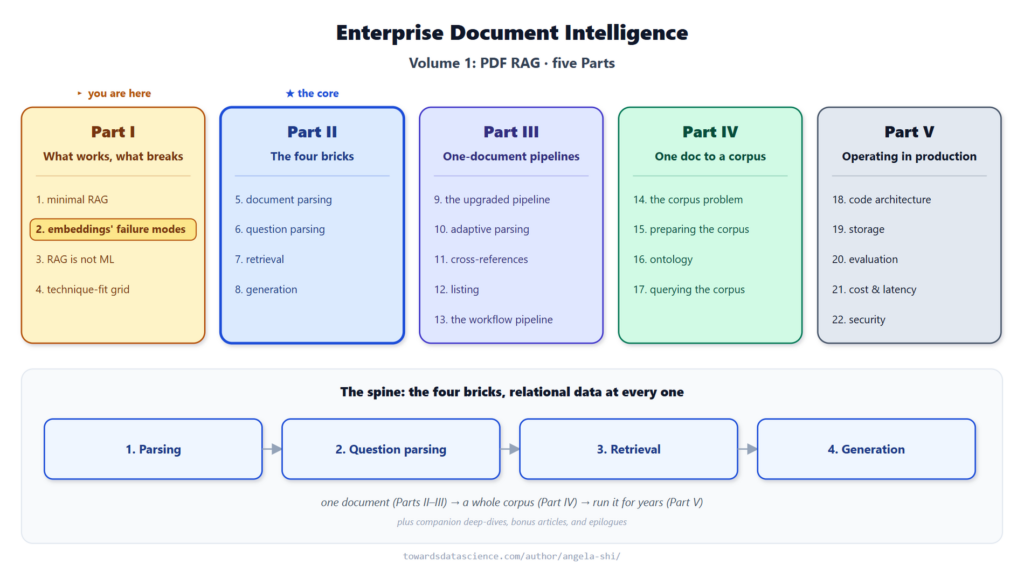
This article sits in Part I, alongside the embeddings triptych (2A / 2B / 2C). Image by author.
📓 Try the reranker on your own PDF at doc-intel/notebooks-vol1. The companion notebook loads a cross-encoder, applies it to a keyword-filtered top-K, and shows both the score and the tokens driving it. Change the query, and watch which keywords carry the ranking.
1. What Data Scientists Say—and Why It Isn’t Enough
Ask a data scientist how a reranker improves RAG, and you’ll likely hear a standard description: it’s a cross-encoder that jointly encodes the query and document, allowing deep semantic matching beyond lexical overlap. While technically accurate, this explanation glosses over the specifics of what the model has learned from its training data. In practice, a reranker learns to weight token co-occurrence patterns—phrases that frequently appear together in relevant pairs—rather than any deep understanding of meaning. The result is that its decisions are driven by surface-level statistics, which can be powerful but also brittle.
2. The Underlying Mechanism: Token Association
At its core, a reranker operates on the same principle as an embedding model: it relies on statistical associations between tokens, learned from large corpora. The key difference lies in conditioning. An embedding model encodes a single text independently, producing a fixed vector representation. A reranker, by contrast, processes the query and a candidate passage together, attending to their mutual context. This allows it to capture interactions—such as matching a specific term in the query to a synonymous phrase in the passage—that are missed by independent encoding.
However, this capability is still grounded in token statistics. For instance, the reranker may learn that “car” and “vehicle” co-occur in relevant contexts, but it doesn’t understand what a car is. This statistical nature makes the reranker effective for many tasks but also means it can be fooled by superficial linguistic patterns.
3. What This Means for Enterprise Architecture
The honest view of rerankers has direct implications for RAG system design in enterprise settings. First, it clarifies the tradeoff: rerankers add latency and computational cost, but they can substantially improve retrieval accuracy when queries are complex or domain-specific. Second, it highlights when a simpler approach might suffice—for instance, if the retrieval corpus is small and keyword matching captures most relevant results, a reranker may be overkill.
Crucially, it also underscores the importance of evaluation. A team should measure the reranker’s impact on downstream task performance, not just on retrieval metrics like recall@k. This requires a clear understanding of the business objective—whether it’s answering customer support queries accurately or retrieving legal precedents—and testing the reranker against baselines like BM25 or dense retrieval without reranking.
4. Practical Guidance: When to Use (and Not Use) a Reranker
Based on this understanding, the decision to deploy a reranker should be driven by specific conditions:
- Complex queries: When user queries are paraphrased, use synonyms, or involve multi-hop reasoning, rerankers add value.
- Large corpora: With many candidate passages, rerankers help narrow down to the most relevant results, improving precision.
- Domain specificity: In specialized fields like medicine or law, rerankers fine-tuned on domain data can outperform generic models.
- Latency tolerance: If your application can afford an additional 50-200 ms per query, rerankers are feasible.
Conversely, avoid rerankers when: the corpus is small (a few thousand documents), queries are short and match keywords well, or strict latency requirements preclude any extra processing. In such cases, the cost of a reranker outweighs its benefits.
5. Conclusion
A RAG reranker is not a mysterious black box. It works by leveraging statistical token associations, conditioned on query–passage pairs, to re-rank initial retrieval results. Understanding this mechanism demystifies its behavior and informs architecture decisions. By evaluating it honestly against simpler baselines and considering the tradeoffs, you can determine whether a reranker is the right investment for your enterprise RAG system—and, if so, how to deploy it effectively.
In an era where AI adoption is accelerating, clarity about model internals is a competitive advantage. The next time someone suggests “just add a reranker,” you’ll know exactly what they’re proposing—and whether it’s worth it.